DECIDE explores how AI can strengthen citizen empowerment and democratic participation. It brings together researchers, policymakers, technologists, and citizens across the Netherlands to develop AI that is explainable, transparent, and inclusive.
The project is structured into work packages, each focusing on a key aspect of citizen-centred and transparent AI.
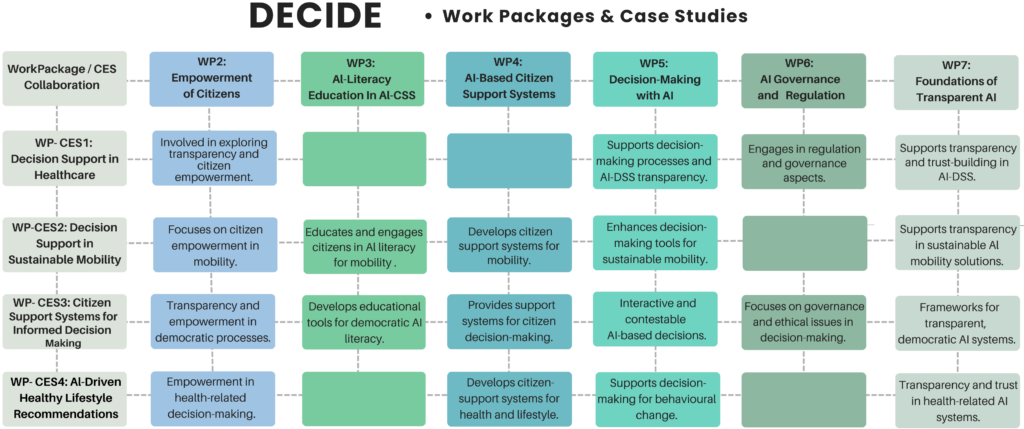
Work Packages
Each work package addresses a key dimension of transparent, citizen-centred AI.
Project coordination & impact
WP1 keeps DECIDE on track. It coordinates the project, supports collaboration between disciplines, and ensures that research results are shared openly and meaningfully with society.
Lead:
Mieke Boon, University of Twente
Institutions involved:
- University of Twente
Societal/Business partners and advisors:
- WAAG Futurelab
- Tetem
- VU Citizen Science Club
- ImproVive
- Forvis Mazars
- Adwise
- Citizen Science Nederland (CS-NL)
Empowerment of Citizens
WP2 studies what empowerment really means when AI is involved. It explores how transparency, participation and understanding can help citizens gain more control over decisions that affect their lives.
Lead:
Wolter Pieters, Radboud University
Institutions involved:
- Radboud University
- Erasmus University Rotterdam
- Utrecht University
- University of Twente
Societal/Business partners:
- NIP
- Human Factors NL
- Waag Futurelab
- iHUB
AI Literacy Education
WP3 develops new ways to teach people how to design AI together. It focuses on AI literacy, co-design methods and education for students, professionals and citizens.
Lead:
Tessa Eysink, University of Twente
Institutions involved:
- Utrecht University
- University of Amsterdam
- Kohnstamm Institute
- Saxion University of Applied Sciences
Societal/Business partners:
- Tetem.nl
- Saxion
- regional ROCs
- Simpaticom (Venturespring)
- Nederlandse Vereniging voor Raadsleden VNG
AI-Based Citizen Support Systems (AI-CSS)
WP4 works on AI tools that help citizens make their own decisions. These AI Citizen Support Systems are designed to support reasoning, understanding and exploration of options.
Lead:
Giancarlo Giuzzardi, University of Twente
Institutions involved:
- University of Twente
- Utrecht University
- Erasmus University Rotterdam
Societal/Business partners:
- Go FAIR Foundation
AI Decision Support Systems (AI-DSS)
WP5 improves AI systems that are used by institutions to make decisions about citizens. The focus is on making these systems more transparent, interactive and explainable.
Lead:
Mehdi Dastani, Utrecht University
Institutions involved:
- Utrecht University
- University of Twente
Societal/Business partners:
- To be confirmed
AI governance & Regulation
WP6 examines how laws and regulations, such as the EU AI Act, shape transparent and responsible AI. It connects technical possibilities with legal and ethical realities.
Lead:
Oskar Gstrein, University of Groningen
Institutions involved:
- University of Groningen
- University of Twente
Societal/Business partners:
- Patientadvicgroup Psychiatrie
- Kennisplatfom AI in de GGZ
- ECNL
- Tairis Medical B.V.
- Waag Future Labs
- Raadsleden VNG
- Adwise
- Fortis Mazars
- European Centre for Not-for-Profit-Law (ECNL)
Foundations of Transparent AI
WP7 looks at the fundamental question: what does AI transparency actually mean? It explores different forms of transparency, their limits, and how explanations can truly make sense to people.
Lead:
Sanne Abeln, Utrecht University
Institutions involved:
- Utrecht University
- University of Twente
Societal/Business partners:
- The Hyve
Case Studies
Real-world applications of transparent AI in different domains
Healthcare
CES1 focuses on empowering citizens and healthcare professionals to demand and use transparent and trustworthy AI in mental healthcare.
Lead:
Dr Maarten van Smeden (UMCU)
Institutions involved:
- Eindhoven University of Technology
- University of Twente
Societal/Business partners:
- Kennisplatform AI in de GGZ
- TAIRIS Medical BV
- Patiëntadviesgroep Psychiatrie (UMCU)
Sustainable Mobility
CES2 develops a transparent AI decision support system to empower SMEs, entrepreneurs, policymakers, and citizens in making informed decisions about sustainable mobility.
Lead:
Dr Yingqian Zhang
Institutions involved:
- Eindhoven University of Technology
- University of Twente
- Jheronimus Academy of Data Science
Societal/Business partners:
- SmartwayZ.NL
Citizen Engagement in Social Decision-Making
CES3 puts citizen participation at the centre of designing and implementing next-generation transparent AI systems.
Lead:
Dr Vivian H.H (EUR)
Institutions involved:
- Eindhoven University of Technology
- University of Twente
- Radboud University
- Erasmus University Rotterdam
- Utrecht University
Societal/Business partners:
- Nederlandse Vereniging voor Raadsleden
- (Venturespring)-Simpaticom
- Blockverse institute
- Dutch VR
- ImproVive
- European Centre for Not-for-Profit-Law
Empower citizens in behavioural changes
CES4 develops transparent AI recommender systems that help citizens make healthier and more sustainable food choices.
Lead:
Guido Camps (WUR)
Institutions involved:
- University of Twente
- Utrecht University
- Wageningen University & Research
Societal/Business partners:
- Verdify
- Voedingscentrum (The Netherlands Nutrition Centre)